
8 Planview Portfolios alternatives in 2026: Which one fits your Jira stack

Key Takeaways
For Jira-standardized enterprise PMOs, Tempo Structure PPM builds portfolio governance from execution data already in Jira – no reconciliation step, deployable in weeks
For PMOs whose issue is vendor trajectory rather than product capability, Broadcom Clarity and Planisware carry comparable governance depth
For CPOs whose governance challenge goes beyond Jira integration depth, your SPM must have visibility across execution systems
Planview alternatives for portfolio leaders in 2026
Planview is a Gartner Magic Quadrant Leader for Strategic Portfolio Management. Planview Portfolios handles the full SPM lifecycle: Investment prioritization and scenario planning, down to portfolio-level visibility across large enterprise programs.
For organizations managing significant strategic spend, it was built at the right scale.
For Chief Portfolio Officers, Planview's strengths come with real trade-offs. Customer reviews and implementation reports consistently surface two pain points:
High implementation complexity. According to 85 G2 reviewers (3.8-star average), Planview can take up to five months to implement. Multiple customer accounts also describe extensive front-end configuration before the platform delivers usable governance data
Manual Jira reconciliation. When Jira is the system of record, PMOs must manually reconcile data between Jira (where teams log tasks and time) and Planview before every review. The portfolio view reflects what was true when someone last ran a Jira export, not what is live.
Organizations searching for Planview alternatives typically arrive at one of two starting points: Either the implementation overhead exceeded what the PMO could sustain, or the Jira–Planview disconnect created more reconciliation work than it was worth.
The next step beyond legacy SPM is a governance layer that maintains real-time portfolio visibility without configuration cycles or manual exports between systems. For Chief Portfolio Officers who need governance without the overhead, the sections below map each alternative to the situation it fits.
What to look for in a Planview alternative
Four factors determine which alternative fits your situation.
Jira integration model: Planview connects to Jira through an integration that sits above it. Jira data has to be pushed into Planview's own data model to generate a portfolio view. An alternative that reads and writes directly from Jira eliminates that reconciliation step. That determines how often your portfolio view reflects the current delivery state
Implementation timeline: Measured as time to first usable portfolio output. Some alternatives deploy in days; others require months of configuration. For PMOs that just survived one long implementation, timeline is rarely a secondary concern
Financial governance depth: CapEx/OpEx classification and budget-versus-actuals tracking separate portfolio management from project tracking. Keep an eye out for tools that provide these at the enterprise depth
Resource planning model: Availability-based planning (real capacity after incidents and meetings) differs from story-point scheduling. The right model depends on whether you are funding programs or managing delivery capacity
Quick overview of eight Planview Portfolios alternatives
Tool | Jira integration | Implementation | Financial governance | Resource planning | Pricing |
Tempo Structure PPM | Native – lives inside Jira | Weeks (Structure PPM) | Deep: CapEx/OpEx, EVM, budget vs. actual | Availability-based via Capacity Planner | |
Atlassian Align | Native – Atlassian product | 3–6 months | Portfolio funding, investment allocation | SAFe team capacity constructs | From $77,400/yr (50 Full users) |
Broadcom Clarity | API integration | 9–12 months | Deep: EVM, cost centers, financial planning | Advanced resource management | Quote-based pricing |
Planisware | API connector, bidirectional | Months | Deep: EVM, budgeting, financial governance | Resource capacity planning | Custom subscription-based pricing |
Smartsheet | API connector, bidirectional | Days to weeks | Basic budget tracking | Workload views | From $9/user/mo (Pro, billed annually) |
ServiceNow SPM | Separate system | 6–12 months | IT investment management | Demand and resource management | |
Adobe Workfront | Third-party connector | 3–6 months | Project budget tracking | Capacity and workload management | |
Wrike | Paid add-on (Wrike Two-Way Sync) | Weeks | Pinnacle+ only | Pinnacle+ only | From $10/user/mo (Team, billed annually) |
The table shows where each alternative sits. The sections below go deeper, starting with the tool built specifically for Jira organizations.
The eight Planview alternatives for portfolio leaders in 2026
1. Tempo: The best Planview alternative built inside Jira
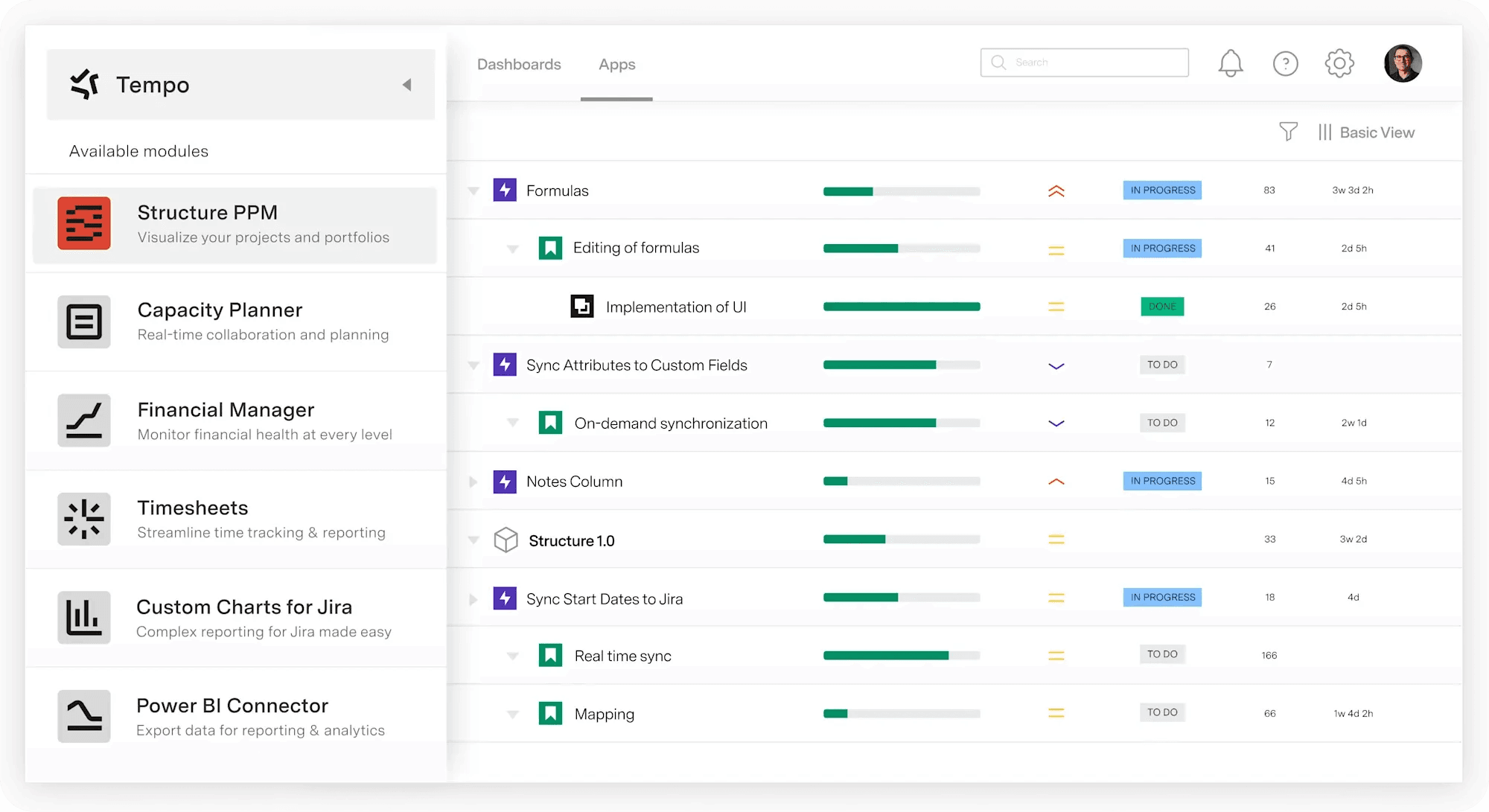
Tempo is a Planview alternative built natively inside Jira. Its products cover the full governance stack: Structure PPM for portfolio hierarchy, Financial Manager for CapEx/OpEx tracking, and Timesheets to log time. Each is available separately and expands without a platform migration.
This is why approximately 30,000 organizations run at least one Tempo product today. For PMOs leaving Planview, two products are directly relevant. Structure PPM replaces Planview's portfolio hierarchy inside Jira.
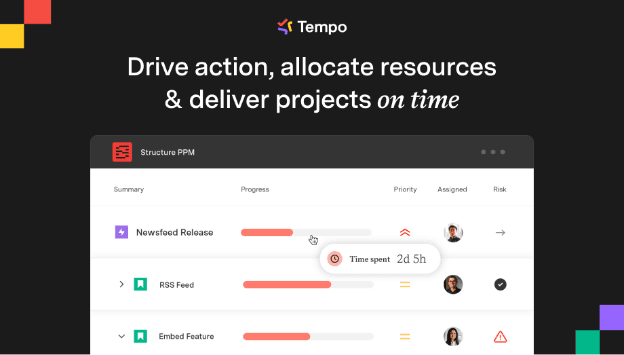
Project and portfolio management
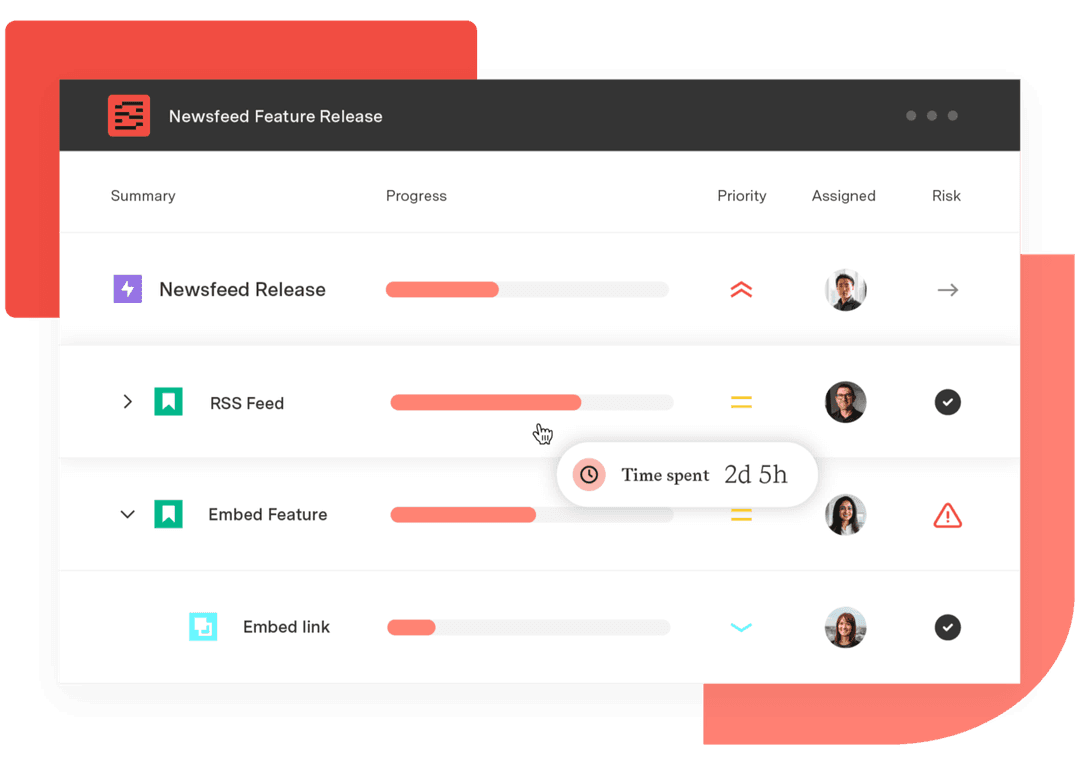
Where Planview sits above Jira and requires extracting delivery data into its own portfolio model, Structure PPM runs inside Jira and builds the governance view from execution data your teams already maintain.
Structure PPM builds portfolio visibility from execution data already flowing through Jira. No separate data layer to populate, no parallel governance system to maintain alongside the delivery tool your teams use every day.
Portfolio directors see the same data delivery teams update in real time. That means the governance view reflects what is currently happening.
Structure PPM also builds configurable portfolio hierarchies inside Jira: Portfolios at the top, programs below, Jira projects and epics underneath. Every layer aggregates live issue data from the levels below it. A portfolio director clicking into a program sees the same information that the delivery team maintains at the project level. No separate data entry or manual status pull before the review.
Inline editing lets you update statuses across 20 projects on one screen, without opening each issue individually. Custom columns also aggregate any Jira field or formula into the hierarchy: Budget remaining, risk flags, health score, or any combination.
When a project slips, the program-level view updates immediately. When you need to report to the board, the data is current without a pre-meeting export cycle.
Financial governance
Add Tempo Financial Manager for the financial layer. It reads logged hours from Timesheets or Jira and converts them to labor costs (CapEx or OpEx categorized) without a manual export step.
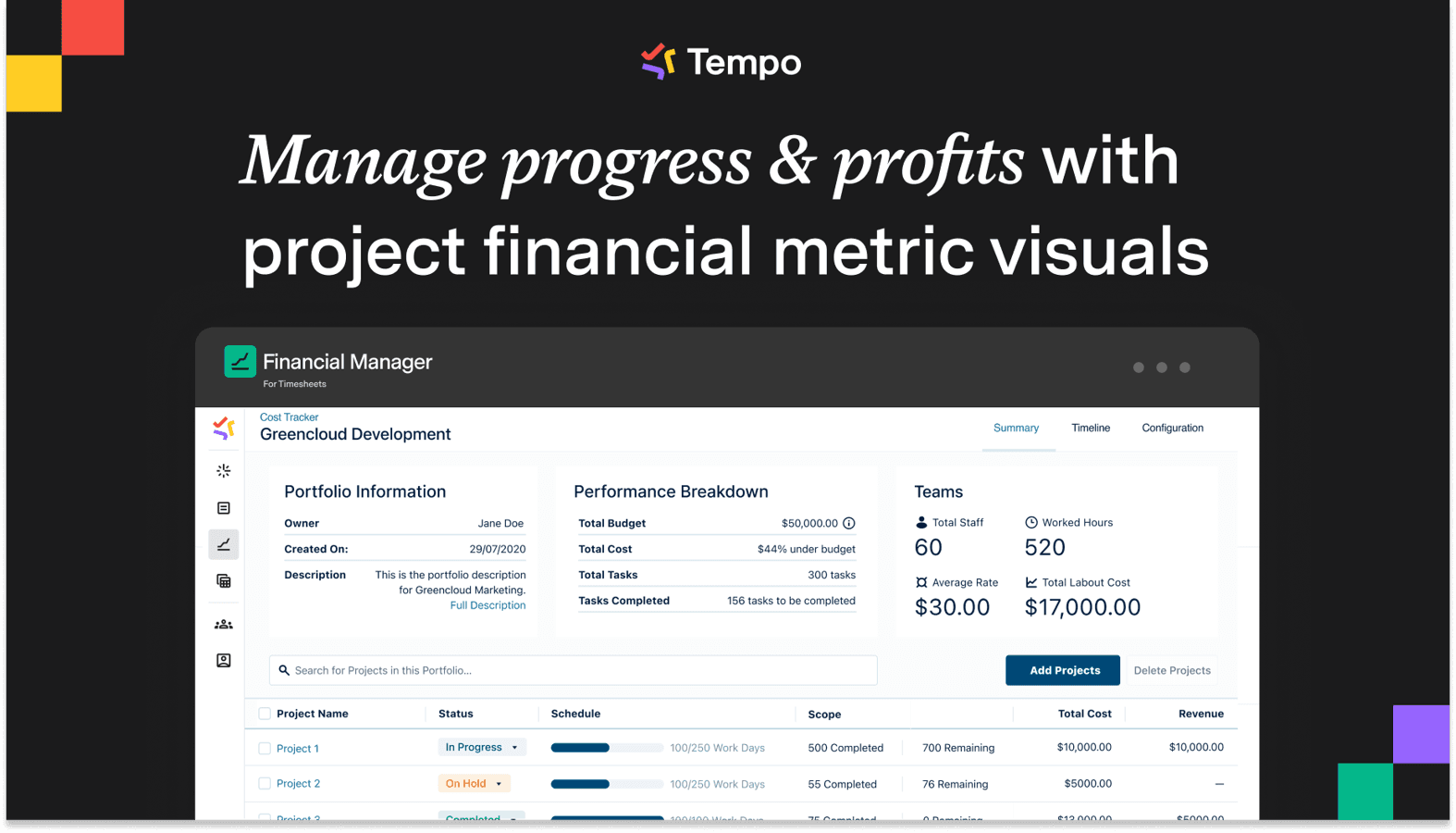
For example, after deploying Financial Manager, BAE Systems’ project managers no longer generate earned value graphs manually. Cost and schedule variance became visible to project teams in real time, enabling corrective action before reviews rather than during them.
Damian Le Gresley, Head of Engineering Improvement, Applied Intelligence division, BAE Systems said he "liked the way it reused existing issue backlogs to create historical earned value and clearly shows progress versus budget."
You can also get an outcome like this when you add Financial Manager to your stack to see all project financials in one place.
Capacity planning
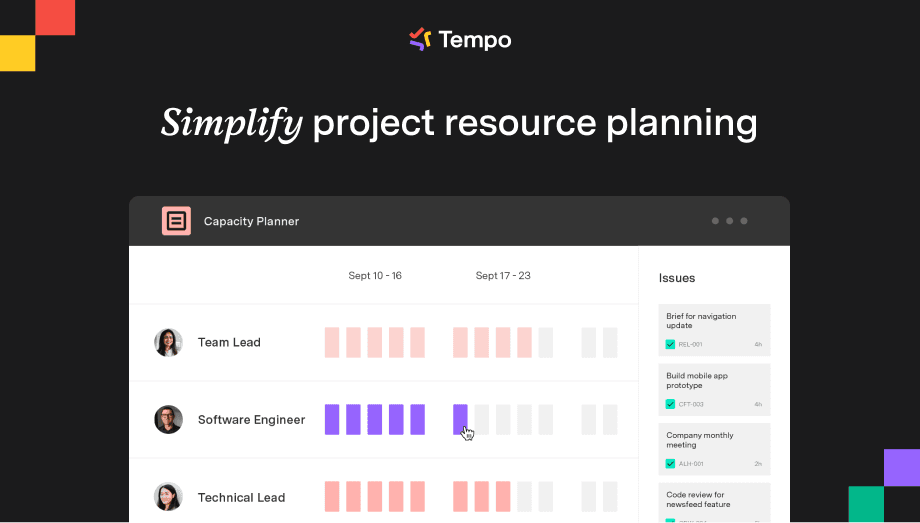
Tempo Capacity Planner shows team bandwidth and availability inside Jira, linked to the portfolio hierarchy. Before committing to a new initiative, a program manager checks whether the required engineering capacity exists without opening a separate resource management tool. Real-time indicators flag overloaded teams before they miss deadlines.
With Capacity Planner, Edwin Amador, Atlassian Systems Administrator at Arizona State University says they can now "pinpoint who needs help, who needs resourcing, where a project is failing, and where a project is succeeding."
You can also configure holiday schemes and workload limits to avoid overbooking and burnout across distributed teams, which makes capacity planning easier.
What comes after configuration-driven SPM
Structure PPM answers where portfolio governance lives today for Jira-first organizations.
The next phase is a governance layer that operates across execution environments. This will not be limited to Jira; It’ll extend to ServiceNow, Azure DevOps, and any other execution environment for your team.
That layer reads live signals from every execution system, surfaces portfolio drift before it requires a review cycle to catch, and removes the per-tool integration overhead that keeps portfolio data perpetually behind delivery reality.
For CPOs governing portfolios that span multiple execution environments, Tempo is building toward that capability.
Pricing
Structure PPM pricing matches your Jira user count. The license covers all Jira users, not only those actively using Structure.
Users | Standard (per user/month) | Advanced (per user/month) |
1–10 | $10/month flat | $20/month flat |
11–100 | $3.52 | $4.73 |
101–250 | $2.37 | $3.23 |
251–1,000 | $2.26 | $2.73 |
A 100-user organization pays $352/month (Standard) or $473/month (Advanced), billed monthly. Annual billing is offered at a lower rate.
Pros
Jira-native architecture: Portfolio governance builds from data delivery teams already maintain. No new data layer required
Modular: Start with Structure PPM, add Capacity Planner or Financial Manager without a platform migration
Reaches productive portfolio reporting in weeks, not the months a Planview deployment requires
Handles 100,000+ Jira issues where Jira Plans stalls at an advisory 5,000-issue performance cap
Atlassian Enterprise Apps Partner of the Year 2024; 2026 Partner of the Year finalist
Cons
Jira-only: Organizations not on Atlassian have no path to Structure PPM
Pricing covers the full Jira user count: You pay for all Jira users, not only active Structure users
2. Atlassian Align
Atlassian Align is for enterprise organizations running scaled agile that need portfolio-to-strategy alignment without building a parallel delivery system. It's not a general Planview replacement, but it's the right swap when the organization is already on Atlassian, running SAFe or Scrum@Scale, and the reason for leaving Planview is vendor complexity rather than governance depth.
Planview targets waterfall-aligned governance PMOs. Atlassian Align addresses a different situation: Engineering teams running scaled agile that need portfolio visibility without building a parallel delivery system.
If your organization runs SAFe and delivery teams already work in Jira, Atlassian Align provides the strategic connection layer above the team execution level. It is not a replacement for Jira; it is the portfolio and strategy layer above it.
Key features:
Real-time strategy-to-execution visibility across programs and portfolios
SAFe, Scrum@Scale, LeSS, Spotify, Disciplined Agile, and custom hybrid framework support
PI planning: Maps team capacity and investment to strategic priorities before each program increment
Dependency management and risk tracking across programs and teams
Portfolio roadmapping tied to live Jira execution data
ART and Solution Train hierarchy management for scaled agile program delivery
Pros
Native Atlassian integration: Portfolio strategy connects directly to the Jira execution layer without a third-party sync
Every major scaled agile framework supported, including SAFe and Scrum@Scale
Single Atlassian vendor relationship for the full delivery-to-portfolio stack
Cons
Financial governance is lighter than Planview's: CapEx/OpEx tracking requires adding Financial Manager
Sold as part of the “Strategy Collection”, not available as a standalone purchase
Pricing starts at $77,400/yr (50 Full users)
Waterfall or hybrid PMOs with limited scaled agile adoption will underuse the platform's core capability
Atlassian Align is sold as part of the Atlassian “Strategy Collection”, not available as a standalone purchase. The collection starts at $77,400/yr (50 Full users).
3. Broadcom Clarity: For governance depth and implementation commitment
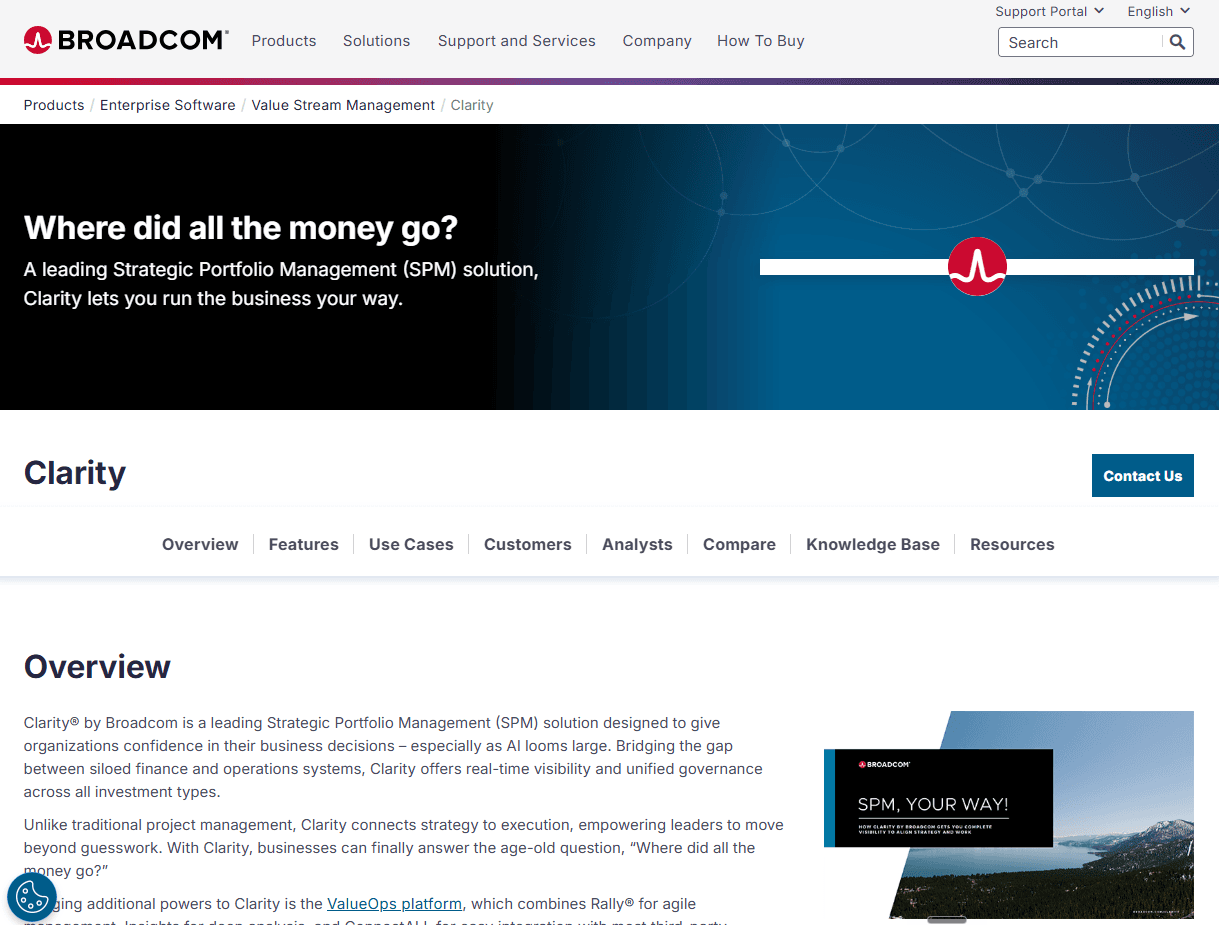
Broadcom Clarity (formerly CA PPM) is the direct peer to Planview at the enterprise governance level. Both platforms were built for large PMOs managing complex portfolios with financial governance and resource management. They also allow scenario planning and hybrid delivery requirements.
If you're leaving Planview over vendor stability or pricing rather than product capability, Clarity delivers comparable governance depth with an established user community.
Key features:
Portfolio and program management with full financial governance
CapEx/OpEx tracking and budget-versus-actuals at the portfolio level
Resource management and capacity planning across large, distributed teams
Scenario planning: Model trade-offs across strategic investment options
Hybrid delivery support: Waterfall, agile, and mixed-methodology portfolios in one platform
Vaia (ValueOps AI Agent), Broadcom's AI agent for portfolio health summaries and project status analysis
Pros
Established user community with deep implementation knowledge across implementation partners
Full hybrid delivery methodology support in a single platform
Cons
Implementation overhead comparable to Planview's. Budget for a multi-month configuration timeline before the platform reflects your organizational hierarchy
Interface has not kept pace with modern design standards; the learning curve for new users is steep
Pricing
Custom pricing.
4. Planisware: For capital-intensive enterprise portfolios

Planisware is enterprise portfolio management software with more than 600 large-cap and midsize customers. Like Planview, Plainsware was purpose-built for strategic portfolio management. Its customer base runs in regulated and capital-intensive industries, where portfolio governance connects directly to investment decisions.
The functional overlap with Planview is that Planisware supports portfolio optimization and scenario modeling. It also supports financial governance at the portfolio level and resource capacity management across large teams.
Its Jira Connector provides API-based bidirectional sync. Jira boards, versions, stories, and epics flow into Planisware's portfolio view. Delivery teams stay in Jira; portfolio managers work in Planisware.
Where it differs from Planview: Planisware's roots are in R&D and engineering-intensive industries. Its portfolio optimization engine uses a particle swarm algorithm for investment prioritization. Organizations in pharmaceuticals, aerospace, and energy tend to be a stronger fit than those in financial services.
Key features:
Portfolio optimization with scenario modeling and strategic alignment scoring across investments
Financial management: Budgeting and cost tracking at portfolio level, with ERP integration for SAP and Oracle NetSuite
Resource management: Real-time capacity visibility across teams, skills, and workload
Bidirectional Jira Connector: API-based, available in Planisware Enterprise v7.0.6+
Hybrid methodology support: Waterfall and agile/PI planning in one platform
AI-assisted portfolio health monitoring and digital agents for task automation
Pros
Direct functional peer to Planview: Portfolio optimization, financial governance, and resource management at enterprise depth
Native bidirectional Jira Connector; delivery teams stay in Jira
Established in regulated and engineering-intensive industries where Planview also competes
30+ years in enterprise PPM with an established implementation partner network
Cons
Implementation is multi-month and configuration-intensive, comparable to the overhead you are leaving with Planview
No published pricing: Requires a sales call
Interface and reporting require significant configuration before the platform reflects your organization's hierarchy
Limited advantage for PMOs whose primary reason for leaving Planview is implementation complexity
Pricing
Uses custom pricing.
5. Smartsheet: Fastest time to visibility, limited financial governance depth
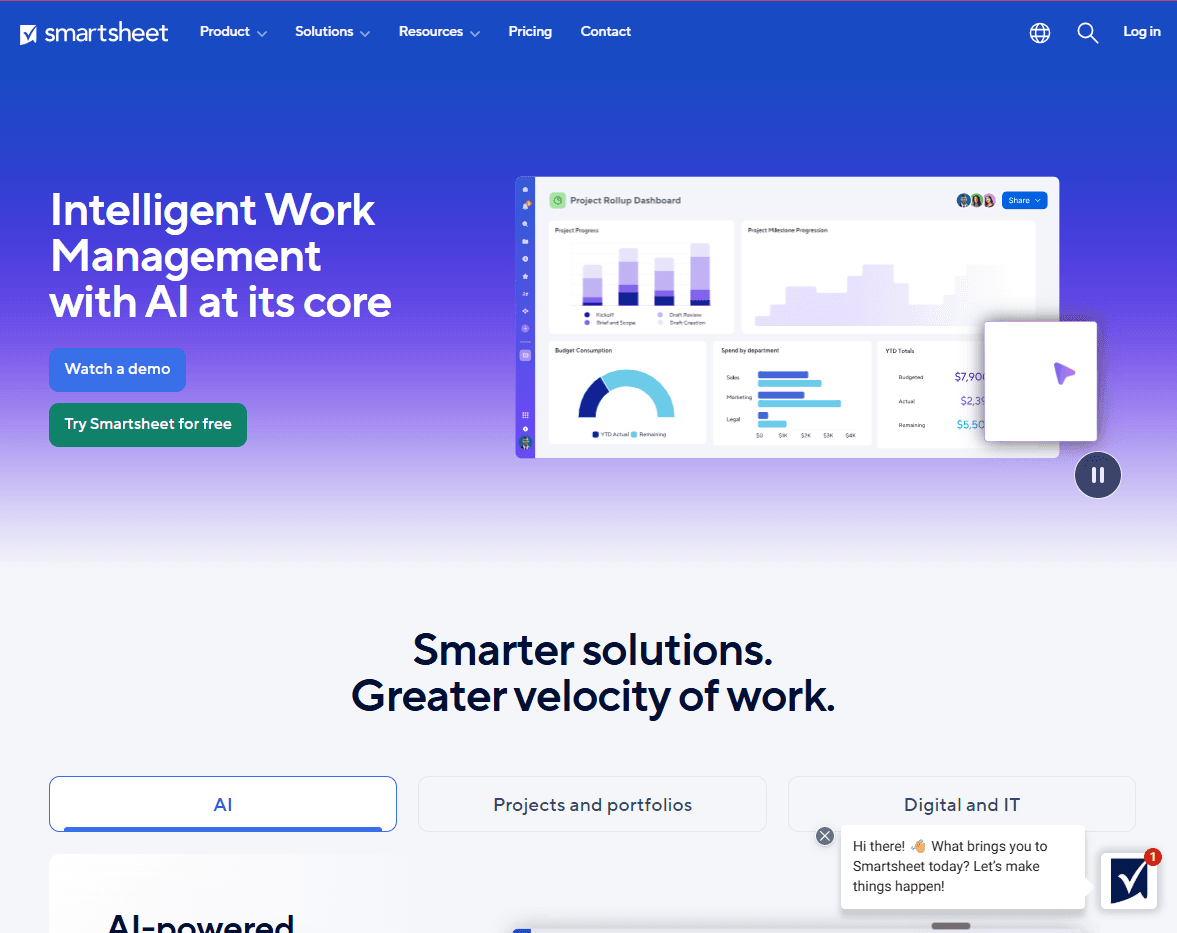
Smartsheet is project and portfolio management software designed for PMOs where adoption speed matters more than governance depth.
It was not purpose-built for strategic portfolio management. But if you used Planview mainly for reporting and visibility, Smartsheet delivers comparable output at lower cost and a fraction of the setup time.
The structural limitation is real though. Portfolio-level financial governance requires heavy configuration in the Advanced Work Management tier. CapEx/OpEx tracking and scenario planning at the investment level are not features of the standard plans. PMOs managing large investment portfolios with finance-grade reporting requirements typically find that Smartsheet serves as a visibility layer, not a governance system.
For teams that rarely used Planview's financial governance depth, Smartsheet is the most accessible option on this list.
Key features
Grid, card, Gantt, calendar, and timeline views in one platform
Portfolio dashboards with roll-up reporting across projects
Automation rules for status updates, notifications, and approval workflows
Jira Connector with bidirectional sync available (paid add-on, Business plan and above)
Resource management in the Business plan and above
Control Center for portfolio templates and governance workflows (Advanced Work Management tier)
Pros
Fastest time to value on this list
Teams that refused to engage with Planview typically adopt Smartsheet without resistance
Transparent entry-level pricing
Cons
Financial governance and CapEx/OpEx tracking are absent at standard tiers; scenario modeling requires the “Advanced Work Management” tier
Portfolio visibility requires manual configuration and does not build automatically from project execution data
Jira integration is via connector; portfolio status does not automatically reflect Jira delivery state.
Full enterprise portfolio management typically requires the Advanced Work Management tier, which is custom-priced.
Pricing (billed annually)
Pro: $9/user/mo
Business: $19/user/mo
Enterprise: custom pricing
Advanced Work Management tier: Custom pricing
6. ServiceNow Strategic Portfolio Management: For ServiceNow-standardized enterprises
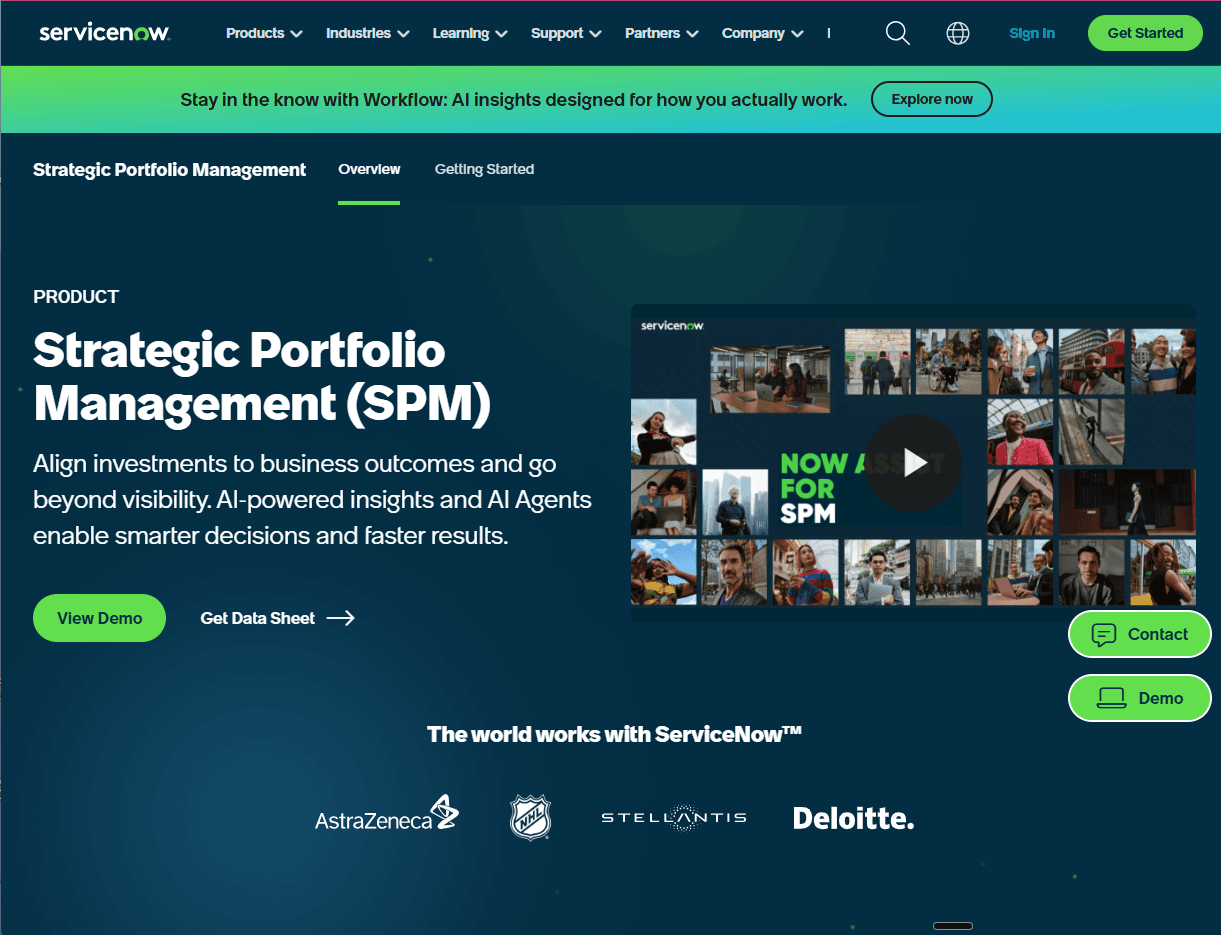
ServiceNow Strategic Portfolio Management is the portfolio governance layer for organizations already standardized on ServiceNow for ITSM. It is a module within the ServiceNow ecosystem, not a standalone portfolio tool.
That distinction is the first thing to confirm before evaluating it as a Planview replacement. If your IT organization already runs infrastructure, demand intake, and approvals through ServiceNow, adding SPM removes the need for a separate vendor relationship. That is the specific situation ServiceNow SPM was designed to serve.
For organizations evaluating ServiceNow SPM without an existing ServiceNow footprint: Adopting SPM means a full enterprise platform purchase. The scope and budget required are considerably larger than migrating from Planview to a dedicated PPM tool.
Key features
Portfolio and program visibility unified with ITSM on a single platform
Demand management: Automated intake, scoring, and approval workflows for new project requests
Resource management with scheduling and utilization tracking
Capability mapping: Links portfolio investments to strategic outcomes
Now Assist AI monitors project health signals and surfaces risks before they escalate
Financial management for portfolio investment tracking
Pros
One platform for demand management and portfolio governance; eliminates a separate vendor relationship
Strong demand management and project intake automation
Now Assist AI for proactive portfolio health monitoring across programs
Established enterprise vendor with a deep implementation partner network
Cons
Organizations not already on ServiceNow face a full platform adoption, not a PPM migration: The budget conversation is an order of magnitude larger than a typical portfolio tool switch
High implementation complexity: ServiceNow deployments typically require a dedicated partner engagement
Heavier than necessary for PMOs that need portfolio visibility without ITSM integration
Custom pricing with no public list rate: The sales engagement is required before any figures emerge
Pricing
ServiceNow SPM uses custom subscription pricing
7. Adobe Workfront: For creative and marketing portfolios
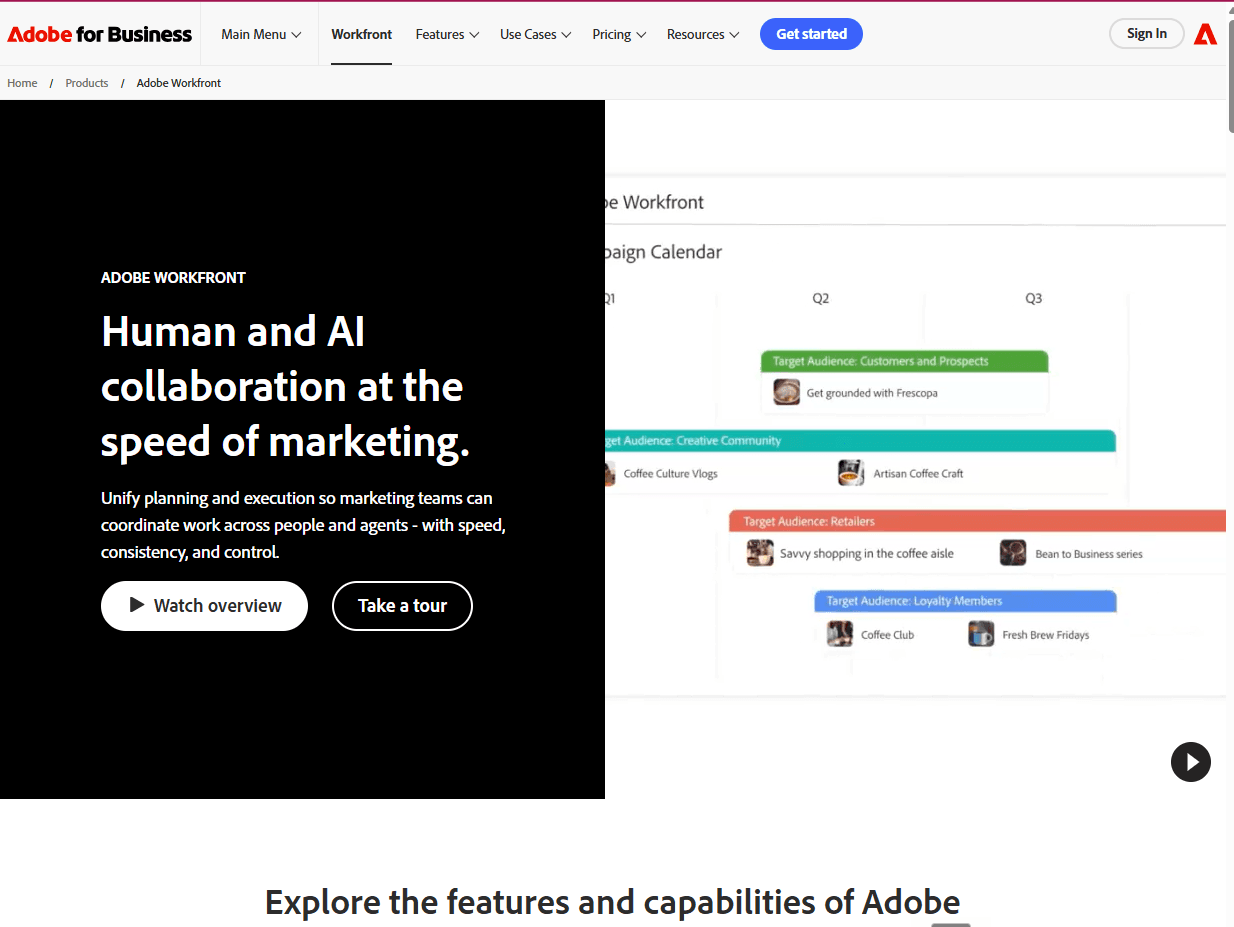
Adobe Workfront is a work management platform built for organizations where the portfolio includes substantial creative production, marketing programs, and content delivery workflows alongside traditional project governance.
PMOs choose it when the project mix (campaign management and brand operations) doesn't map to the governance-first structure most SPM alternatives were built for.
As part of Adobe Experience Cloud, Workfront integrates natively with Adobe Creative Cloud, Marketo, and the broader Adobe stack.
For marketing teams managing cross-channel campaigns alongside programs, that integration removes the manual handoffs between production tools and project tracking. Creative approvals and stakeholder sign-off flow within the same system as the project plan.
The trade-off is Jira depth. Workfront's Jira connector is third-party. For PMOs at Jira-standardized organizations, Workfront adds a new tool stack rather than building on what you already use. Financial governance for engineering portfolios is thinner than Planview's. And the platform's creative workflow strength doesn't apply to the engineering-heavy program portfolios.
Key features
Portfolio, program, and project management with workload balancing
Scenario planner: Model resource allocation and investment options across programs
Review and approval workflows for creative assets, content, and stakeholder sign-off
Workfront Fusion (Ultimate tier): No-code automation connecting Workfront to external systems
Native Adobe Creative Cloud integration: Design files link directly to project tasks
Reporting and dashboards with customizable views across portfolios
Pros
Purpose-built for creative and marketing portfolios: The only option on this list that handles content production workflows alongside program governance
Native integration with Adobe Creative Cloud, Marketo, and Adobe Experience Cloud
Scenario planner provides workload modeling across programs without manual spreadsheet work
Cons
Jira integration is third-party: Portfolio status does not automatically reflect Jira delivery state
Financial governance for engineering portfolios is lighter than Planview's
Pricing requires a full sales engagement to evaluate total cost
Primary value sits inside the Adobe ecosystem: Limited advantage for PMOs outside it
Pricing
8. Wrike: For workflow automation for process-heavy enterprise PMOs
Wrike is project and portfolio management software for mid-to-enterprise teams that need stronger workflow structure and process control.
Where Planview targets large PMOs managing investment portfolios, Wrike targets PMOs that need intake management, approval routing, and workflow automation.
For teams evaluating Wrike as a Planview replacement: The financial governance features that make Planview valuable for CPOs are only available in Wrike's Pinnacle tier. The “Business” tier ($25/user/month) covers custom workflows, approval routing, and even automation, but excludes portfolio-level financial governance or CapEx/OpEx tracking.
Jira integration is available through Wrike Two-Way Sync, which connects Wrike to 22 integrated systems, including Jira. It is a paid add-on on “Business” and “Pinnacle” plans and is included natively in the “Apex” plan.
Key features
Custom workflow and approval automation: Suited for PMOs that manage intake and sign-off processes alongside delivery
Budget and cost tracking at Pinnacle+ for teams that need financial visibility
Dashboards and reporting with configurable views across projects
Pros
Easier to set up and use than Planview
Time tracking with billable rate support on “Business” tier
Bidirectional Jira sync available via paid add-on
More accessible entry price than SPM platforms at the “Business” tier
Cons
Financial governance requires at least “Pinnacle”–iIf CapEx/OpEx tracking is the reason for leaving Planview, you’d need to be on its “Pinnacle” tier for that (custom pricing)
Jira sync is a paid add-on on all plans, adding cost and a separate dependency
Not purpose-built for portfolio-level SPM governance: Better suited for process-heavy PMOs than investment portfolio governance.
Pricing (billed annually)
Team: $10/user/month
Business: $25/user/month
Pinnacle: Custom pricing
Apex: Custom pricing
The clearest path forward starts in Jira
For CPOs at Jira-standardized organizations, most Planview exits share a common pattern. The portfolio view requires an extraction step before it can reflect the current delivery state.
Structure PPM removes that step. Portfolio hierarchy, capacity planning, and financial governance all build from your existing Jira data.
The Škoda Auto team runs this at scale, tracking work and resource allocation across digital initiatives while maintaining audit-ready portfolio data without a reconciliation export before every review.
Martin Sahula, Expert Coordinator, Group Software Delivery at Škoda Auto says "Tempo helps us gain insight into work progress and resource allocation to support operational decisions."
Start a 30-day free trial of Structure PPM.